
Maths
At Ettington C of E Primary School and Pre-School, we believe that every child can flourish as a mathematician. Our Mathematics curriculum is rooted in our Christian vision of providing opportunities for all children to develop the gifts and talents they have and to embrace “Life in its Fullness” (John 10:10). We are committed to ensuring that every pupil, whatever their starting point, background, needs or circumstances, is given the opportunity, support and encouragement to succeed in mathematics.
At Ettington, we deliver a ‘Mastery approach to Mathematics’, enabling children to develop deep, secure and sustainable learning. We recognise that children learn at different rates and in different ways, and therefore our approach focusses on identifying and addressing barriers to learning rather than placing limits on what children can achieve. Through carefully sequenced learning and a small-steps approach, pupils are supported to develop secure knowledge, fluency and understanding before applying their learning in increasingly challenging contexts.
Inclusion is at the heart of our mathematics curriculum. We believe that high expectations and appropriate support should go hand in hand. To support all pupils, we provide carefully considered scaffolding, representations, resources, modelling and opportunities for practice so that the children can access the same rich mathematical concepts.
We recognise and celebrate that children bring different experiences, strengths and ways of thinking to mathematics. Our classrooms provide a safe and supportive environment in which children are encouraged to make mistakes, learn from them and persevere. We aim to show children that being successful in mathematics is not about being the quickest or getting every answer right, but about thinking, making connections, explaining ideas and persevering when something is challenging.
Our aim is to equip all pupils with the knowledge, skills and confidence to solve a range of mathematical problems through fluency with numbers and mathematical reasoning. We want children to recognise and value the mathematics that surrounds them in everyday life and to understand how mathematical knowledge can open doors to future learning and opportunities.
At Ettington, we have been on a journey over several years to improve the teaching and learning of mathematics, so that it is ambitious and accessible to the needs of every learner.
MATHEMATICS PLANNING
Whole class together – we teach mathematics to whole classes and do not label children according to ability. Lessons are planned based on formative assessment of what students already know and we include all children in learning mathematical concepts. At the planning stage, teachers consider the scaffolding that may be required for children struggling to grasp concepts in the lesson and challenge ‘depth’ questions for those who may grasp the concepts rapidly. In line with NCETM advice and much academic research, one form of depth frequently used, during the first part of the lesson, is variation theory (conceptual and procedural). Variation is one of the five ‘big ideas’ at the heart of Teaching for Mastery. For example, a child who can produce a quick correct answer may be asked to solve the question using more than one other procedure, to represent the question in more than one way (such as the bar model or part whole), to write another question using the same numbers and operation. This ensures that the children have a deep understanding of the objective being taught.
Longer but deeper – in order to ensure children have a secure and deep understanding of the content taught, our plans have been adjusted to allow longer on topics, and we move more slowly through the curriculum. We currently use ‘White Rose’ alongside NCETM Mastery of Number to support us in our planning and delivery of the National Curriculum Aims. Teachers adapt each lesson to meet the needs of their children and add extra questioning / tasks which will allow children to learn the content more deeply. The learning will focus on one key conceptual idea and connections are made across mathematical topics. To outsiders, it may appear that the pace of the lesson is slower, but progress and understanding is enhanced.
Key learning points are identified during planning and a clear journey through the maths should be shown on flip charts (also reflected on working walls). Learning points may appear to be very small, but this is deliberate. For example, a whole lesson may be spent on adding the ones to a 3-digit number. The expectation is that every child will master the concept and some children will work more deeply on the same concept using variation theory and challenge tasks.
Questions will probe pupil's understanding throughout, taking some children’s learning deeper. Responses are expected in full sentences, using precise mathematical vocabulary.
D – Do you agree? (Active argument)
E – Explicit use of misconceptions (i.e. what it is / what it is not)
P – Probing questions
T – The missing digits / symbols
H – Here’s the answer. What is the question? What do you notice? What do you know?
We are confident that learning at a steadier and deeper pace, benefits all children. This ensures no child is left behind as well as providing challenges to stretch and deepen children who grasp content quickly.
TEACHING AND LEARNING
The Mastery Approach to Mathematics ensures that where possible there will be fewer gaps in learning.
In lessons, you will see:
•We are spending longer on one problem or concept.
•Whole class participation with pupils taught together, most of the time.
•Whole class targets the concept to be mastered in this unit of work.
•Independent practise time when pupils apply their new knowledge in multiple ways.
•Pupils talking to each other to secure their learning and try out ideas.
•Teachers target questions to individuals to deepen their knowledge.
•Verbal feedback during lessons, self-marking by pupils and highlighting of correct work. In line with the marking policy, maths marking is swift. This allows for quick identification of children who may require additional support in the new learning the following day.
•Pupils working in mixed ability pairs/groups.
•High expectations of pupil responses in full sentences (stem sentences) with mathematical terminology and explanations.
•Use of real-life applications wherever possible to make learning relevant.
•Giving children who need it, additional support, over a short period of time.
•Challenges available linked to current learning to deepen understanding of children who grasp the content more quickly.
•Regular reviews of learning.
…the answer is just the beginning.
Exploration – instead of ‘Let me teach you…’ or giving a learning objective as a starting point, children are encouraged to explore a problem themselves to see what they already know. At the beginning of each lesson, this exploration is referred to as the ‘anchor task’. During this time, the teacher and teaching assistant will spend time observing and questioning the children. The understanding of children who provide a quick, correct answer will be probed further using questions based around variation theory.
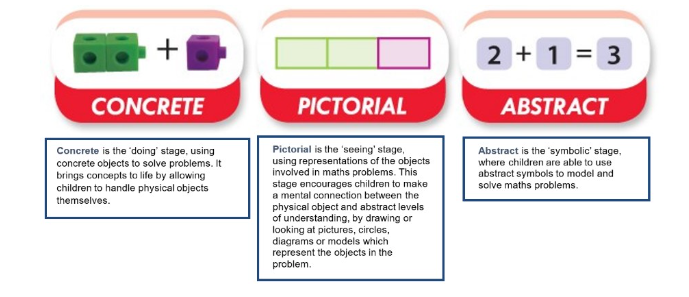
Develop reasoning and deep understanding (contexts and representations of mathematics) – problems are often set in real-life contexts – carefully chosen practical resources and pictorial representations are used to explore concepts. These pictorial representations will appear in books as children show their understanding, rather than answers to a series of calculations. The use of practical resources, pictorial representations and recording takes place in every lesson (the CPA approach).
Structuring – the teacher will organise the findings of the exploration, compare/contrast strategies and guide toward the most efficient strategy (or the one being learnt that day).
Step by step approach – journey through mathematics (these steps may appear small, especially at the beginning of a lesson, there are points when suddenly a jump appears to have been made, or an extra challenge appears – this is normal).
Questions to challenge thinking – teachers use questioning throughout every lesson to check understanding – a variety of questions are used, but you will hear the same ones being repeated: How do you know? Can you prove it? Are you sure? Can you represent it another way? What’s the value? What’s the same/different about? Can you explain that? What does your partner think? Can you imagine?
Due to the episodic style of the lessons with frequent questioning, lessons may appear to move slower than in the past. There will be more talking and less recording in books. We do not want children to attempt independent recording until we believe they are secure with the concept. We do not want them to practise errors.
Discussion and feedback – pupils have opportunities to talk to their partners and explain/clarify their thinking.
Rapid intervention (small group catch up) – in mathematics, new learning is built upon previous understanding, so in order for learning to progress and to keep the class together, pupils need to be supported to keep up and areas of difficulty must be dealt with as and when they occur. We do this through a small group intervention session (daily where possible) of 15 – 20 minutes in the afternoon. In addition, we still run intervention sessions outside the maths lesson for some targeted children, e.g.: Catch Up, pre- or post-tutoring, fluency groups…
Marking – the marking policy has been amended following the guidance of the NCETM. Current marking policy is that learning is ticked, and a comment is only made if/when a teacher feels it is necessary to move learning forward. Gap tasks may appear for individual children in their books, but usually gaps are addressed through same day catch up and therefore will not be recorded in books. The most valuable feedback is given during a lesson.
Some children may be supported by additional adults, different resources, differentiated activities. They may also complete additional activities outside the mathematics lesson.
NB: We do not label our children. We have high expectations of all children and strongly believe that all children are equally able in mathematics. Some may take longer to grasp concepts and may need careful scaffolding or extra time/support (guided groups, same day catch-up, pre-teaching, intervention group, specific parent support).
ASSESSMENT
In line with the school Assessment and Monitoring Schedule, the children in Years 1, 3, 4 and 5 are formally assessed using White Rose Assessment materials at the end of Autumn 1, Spring 1 and Summer 1. Children in Years 2 and 6 are assessed using KS SATs material. Year 5 use a combination of curriculum and KS2 SATS material. Teachers are continually formatively assessing learning. Assessment judgements are recorded termly. This data is analysed in order to ensure that children are making at least ‘Good’ progress. Where progress or attainment is deemed to be below our expectations, conversations will be held with the relevant staff to see whether further support is required.
CURRICULUM CPD
The school has been part of the Central Maths Hub Teacher Research Group (TRG) and Sustaining Mastery Groups. Both Mrs Crowe and Mrs Kemp have participated in the study and disseminated their learning across the school. As Maths Lead, Mrs Kemp will continue to deliver staff training on teaching the Mastery Approach to Mathematics – working with teachers, teaching assistants and parents in supporting and extending the children’s maths learning experiences as well as develop her own Curriculum Professional Development by being part of the Origins Maths Hub on Sustaining Mastery.
In the Early Years and KS1, teachers have participated in 'Mastering Number' programme as part of the Origins Maths Hub, developing Early Number and Early Pattern to ensure our children have the best 'number knowledge' start to life.